
Standing before the window, Soledad gazes at the mist that covers her garden in a somber and melancholic landscape. Among the trees and withered flowers, a shape catches her eye, disrupting her routine. Vultures circle overhead, foreshadowing a horror she fears to confront. While her dogs rest peacefully at home, the suspicion of their involvement in a series of brutal attacks haunts her.
Nº 06 | Short story | Horror | 1434 words | Translated by Trinidad Montalva
THE VULTURES
ZEZÉ ATABALES
She didn’t know. The man’s hands, out of control,
ran up and down the baby’s soft-skinned body, the sinuous
limbed-less body. Oh my God, my God. Her head moved
and her muscles contracted in a bitter spasm of hysteria. Her
fingers closed over her daughter. Oh my God, she didn’t know…
«Only a mother», Judith Merril
Soledad is staring throw the window. The day is cold, and the fog hangs over the sea like a white thick mirror with no reflection. The colors of the garden seem muted and lifeless, a landscape she finds beautiful. She observes the plants: a withered tree with branches like spiderwebs, a relentless reed bed, two ancient pines, a rosebush climbing like a vine with its blood-red blossoms. She surveys the space she knows so well in a methodical reverie until her eye catches a strange figure that doesn’t belong there, abruptly interrupting her otherwise vague thoughts. In the north corner of the garden, right next to the fence, there is a lump.
Her heart leaps up her throat; a sharp, piercing sound drills into her ears; she finds a chair and sits down.
She looks up and sees the vultures flying.
The birds, dressed in mourning, silent and predatory, glide with their wings painted white at the tips. Their necks are featherless, and their heads are red. Soledad is used to seeing them here, nearby. One of the vultures perches atop the oldest pine tree, and with a subtle movement of its wings, falls on one of the branches like a Spanish blanket. It’s watching the lump. Then, spreads its enormous wings like a sunrise and flies in ascending circles until it looks just like a dot against the landscape. Soledad follows it with her eyes until it disappears into the vastness of the open sky.
She inhales deeply through her nose, expanding her chest to fill her lungs completely, counts to three, and exhales slowly through her mouth. She repeats the exercise and looks at the two dogs resting on the mustard-colored sofa. Raúl, a territorial and effusive Akita, sleeps lying back with his legs up, revealing his furry, cream-colored stomach. Ramiro, a mixed-breed dog of indeterminate lineage, reserved and affectionate, untrusting of strangers, rests with his paws over his eyes. Soledad pauses at this image and smiles. Above them, a painting of a chili pepper, rendered in realistic style, draws her into its red color, invoking the aroma of ripe, almost rotten fruit into her mind. A scorching sensation begins in the pit of her stomach, burning her like magma.
She gets up from her chair and goes to the kitchen. She fills the kettle with water and puts it on to heat gently. She checks the pantry and organizes the jars of food, washes a plate with leftovers from last night’s dinner, and decides to clean the refrigerator. She throws away empty vodka bottles, some butter with bits of toast, and mustard packets she steals from restaurants and never uses. The kettle whistle announces it’s time for her tea.
From the cabinet, she grabs her favorite cup. On it, enclosed in a heart, is a photo of her puppies in the snow; above the image is the phrase «Happy Mother’s Day». She grabs a cinnamon stick, puts it in, and fills the cup meticulously: three-quarters with hot water and the rest with cold water. She cuts a piece of bread and spreads pumpkin jam on it, sits down at the table, and watches her dogs, who, used to being the kings of the house, wake from their nap when they hear the spoon tap against the rim of the mug. They both come over, wagging their tails, and sit beside Soledad’s legs, looking at her with hanging tongues and teary eyes. She divides her bread into three pieces and gives a portion to each of them. She strokes their heads and kisses them, inhaling the metallic scent emanating from their muzzles. The fire rises in her throat, which closes. She takes another sip of the lukewarm liquid, knowing that cold, almost freezing water would be better. She glances at the garden; the lump is still there.
She watches the hours go by, hoping the darkness of the night will leave her no choice but to lie down and rest. The vultures, still circling her house, and their presence as an inescapable reminder that all has to end, make her stand. She clasps the thumb of her left hand with the fingers of her right and walks to the door, her breath stuck in her throat. She tries to clear her mind, but her senses are disturbed; everything is blue and red. She pauses in the doorway and looks at the garden, turns around, and goes back inside.
She goes up to her room and closes the curtains. She takes off her shoes and lies down under the covers, regretting having canceled her internet subscription; she could have immerse herself in the endless loop of a series instead of waiting for the threat of menacing silence. She thinks about vacuuming, perhaps organizing the clothes in her closet by color, or taking a nap in the hope that the strange body will no longer be there when she wakes up. She remains lying down, the burning sensation increasing, and begins to count aloud. At fifty-four, she jumps up.
She walks to a white cabinet located in front of the exit door and opens it. Inside, a jumpsuit with red stains and rubber gloves await her. She closes it without taking anything out and shouts. She sits down next to her dogs and buries her face in their furry cheeks. They, hearing the sound of a motorcycle passing in the distance, run.
Soledad puts on the jumpsuit, the gloves and goes out to the garden.
Steady yet slow, she walks the distance to the fence. The fire inside her bursts at the corner of her mouth as the vultures circle overhead. This isn’t new. She offers a half-hearted prayer that the lump is just a garbage bag thrown into her yard by some unscrupulous neighbor; she doesn’t want to repeat the horrifying routine of finding a dead animal. She’s counted fifteen, three in the past week. Nine cats, a swan, two coypus, an opossum, and two dogs. One of the dogs was white and fluffy; she’d seen its picture on a WANTED sign plastered on the town’s store. The other was large and brindle; when she found it, its eyes were wide open, horror etched in its gaze. They all bore the marks of the same attack: their stomachs sunken and ripped open. She’d buried them all in the garden.
She’s certain her dogs are responsible.
Not only for the ones she’s found, but also for the killings in the neighbors’ farmyards and chicken coops. It’s hard for her to imagine her puppies, so docile and affectionate, attacking and slaughtering others. She doesn’t understand why they do it, but her heart sinks at the thought that someone might discover the truth.
She watches as a vulture dives and lands without raising a dust cloud, joining its friends already pecking at the lump on the ground. Soledad walks past the birds, who, busy with their scavenging, don’t notice her presence. Up close, they smell just like her dogs.
The scene disturbs her eyes; she has to lean against the fence to keep from fainting. She screams, shoving her fingers into her mouth to stifle her cries, and after straining her throat and pulling them out dripping with blood, she yells even louder. Only by looking away can she control herself, and stop screaming. She tries to recall the various yoga exercises she learned, she tries to think of a pink dot in the middle of the sea, but reality blurs everything, and all she can see are birds piercing the arm of a small body. Hypnotized, she moves closer and closer until she is surrounded by vultures that reach her chest and watch her out of the corner of their eyes. The body is naked and battered; it’s a child. He has deep, bleeding wounds on the neck, stomach, and pubis. The infant looks at her pleadingly; he is still alive.
Soledad turns around.
She goes back inside and strokes the heads of her dogs, who greet her happily wagging their tails, and comes out with a shovel in her hand. She walks over to the feast of the emissaries of death and thinks; this time, she will have to dig a much deeper grave.
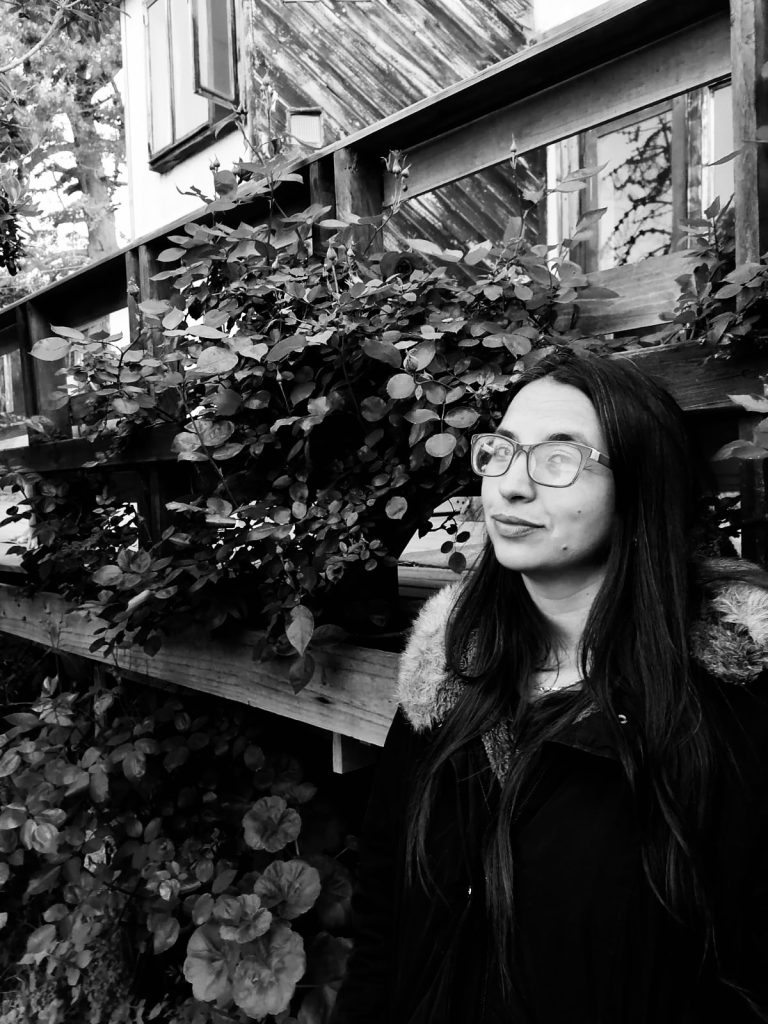
Zezé Atabales (Santiago, 1994) is a Chilean horror and science fiction writer. She has published short stories in horror anthologies in Mexico, Argentina and in the Chilean magazine Imagi. She is a part of Cabezas en la ventana; Anthology of Latin American horror, a volume that brings together unpublished texts by authors of the genre in the region. She received an honorable mention in the Encrucijada Laboratory International Competition in Cuba. She recently won a grant from the Ministry of Cultures, Arts and Heritage and is currently writing her first book of short stories.